
World Wars & the Birth of Europe
A 14-Day Journey Through Memory, Borders, and Consequence
This journey traces the fault lines of modern Europe. From the beaches of Normandy to the battlefields of Verdun, from Alsace’s shifting identity to the institutions of the European Union, we move slowly through places where history fractured — and where reconciliation was later imagined.
Your Week at a Glance
This guided World Wars journey is designed for travelers seeking historical depth rather than surface-level tourism. Moving through Normandy, Verdun, Alsace, and Strasbourg, we trace how twentieth-century conflict reshaped borders, memory, and the political foundations of modern Europe. Specific sites are named intentionally, while the deeper rhythm and interpretation of each day are guided on the ground.

Day 01
Departure - Long Travel Day
Guests make their way from the U.S. to Paris. This is a full travel day with arrival the next morning.
Day 02
Normandy
Arrive in France (typically via Paris), then travel onward by rail to our base in Normandy.
This first evening is intentionally light. Our base is an historic center providing a calm setting to decompress after long travel. Depending on arrival time, we may take a short orientation walk through town before dinner.


Day 03
The Allied Landings
We begin our Normandy exploration along the central sectors of the invasion coast.
Sites may include:
-
Arromanches-les-Bains (Gold Beach) and the remains of the Mulberry Harbor
-
Juno Beach area, focusing on the Canadian landings
-
A museum providing context for Operation Overlord and the logistics of invasion
This day emphasizes planning, coordination, and scale rather than combat alone.
Day 04
Omaha and the American Experience
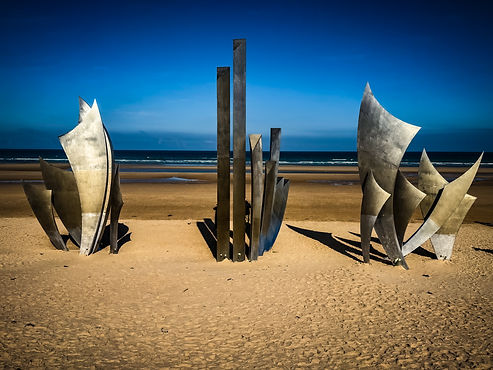
A full day focused on the American sector of the landings.
Key sites include:
-
Omaha Beach
-
Pointe du Hoc
-
Normandy American Cemetery
The day is paced deliberately, with space for reflection and grounding before returning to our base.


Day 05
Beyond the Battlefields
A pause from war sites to balance the emotional weight of the previous days.
Possible destinations include:
-
Honfleur or
-
Dinan
This day offers cultural and geographic contrast and allows time to absorb what has been experienced before moving east.
Day 06
Normandy to Metz
In moving from the beaches of 1944 to the fields of 1916-17, we shift from battlefield to industrialized warfare — a move that reshaped the meaning of combat and national identity.
Evening at leisure in Metz.


Day 07
Verdun & the Meuse–Argonne
A full day devoted to World War I and industrialized warfare.
Sites include:
-
Meuse–Argonne American Cemetery
-
Butte de Vauquois, including its underground battlefield
-
Douaumont Ossuary
The sequence follows geographic logic and emotional progression, focusing on scale, endurance, and consequence.
Day 08
Metz — Borderlands and Empire
-
We begin the day in Colombey-les-Deux-Églises, examining France’s postwar political reckoning, before returning to Metz for an afternoon exploring the city’s layered history.


Day 09
Strasbourg — Identity & Duality
-
Arrival in Strasbourg and immediate immersion into the city’s layered history.
-
We begin with a guided city walk focused on Strasbourg’s dual identity and contested past, including:
-
Petite France
-
Saint-Pierre-le-Jeune
-
Neighborhoods shaped by shifting borders, religion, and language
-
This day introduces Alsace not as scenery, but as lived history.
Day 10
The Vosges — Struthof
-
A solemn day focused on Nazi occupation and repression.
-
We visit:
-
Natzweiler–Struthof, the only concentration camp on present-day French soil
-
Optional visit to the Alsace–Moselle Memorial if time and group energy allow
-
This day is handled with preparation, care, and restraint.


Day 11
Alsace — Wine Route & Villages
-
A cultural and restorative day.
-
We travel along the Alsace Wine Route, stopping in villages that reflect:
-
regional architecture
-
agricultural traditions
-
Franco-German cultural continuity
-
This day intentionally counterbalances the weight of earlier sites.
Day 12
Europe After the Wars — Strasbourg’s Role
-
A day focused on what followed conflict.
-
We explore:
-
European Parliament
-
Postwar European institutions
-
Strasbourg Cathedral
-
Selected museums tied to civic and historical identity
-
This day explicitly connects the wars we’ve studied to the European project that emerged afterward.


Day 13
Free Day & Departure Transition
-
A flexible final day in Strasbourg.
-
Trina remains available to:
-
guide informal exploration
-
share meals
-
assist with individual interests and questions
-
Later in the day, guests travel independently by train to CDG airport-area hotels.
-
Guests who wish to spend time in Paris may do so independently.
Day 14
Departure
-
Independent departure from Paris Charles de Gaulle Airport.
